Wholesale Hair Extensions: How I Evaluate Quality, Suppliers, and Long-Term Value (Stylist Guide 2026)
If you’re looking into wholesale hair extensions, you probably compare pricing, textures, and suppliers.
I used to do the same.
But after working with different hair over time, I realized something simple:
The real difference doesn’t show up when the hair arrives — it shows up after installs, washes, and repeat orders.
I’ve seen beautiful hair turn unusable after two washes. I’ve also seen average-looking hair outperform everything else long-term.
So I stopped chasing appearance and started evaluating performance.
In this guide, I’ll walk through exactly how I choose wholesale hair extensions — based on what actually holds up in real salon work.
Quick Answer: How Do I Choose the Best Wholesale Hair Extensions?
I choose wholesale hair extensions based on cuticle alignment, sourcing consistency, wash performance, and batch stability — not initial softness or price.
The best wholesale hair extensions usually have:
- 100% cuticle-aligned Remy human hair
- Sourcing from single donors or original braids
- Double drawn thickness (full from root to tip)
- Minimal chemical processing
- Consistent color and texture across orders
If the hair fails after washing or changes between batches, I don’t use it — no matter how good it looks at first.
What Wholesale Hair Extensions Actually Mean (And Why Most People Misunderstand It)
Most people think “wholesale hair extensions” means cheaper hair in bulk.
I don’t see it that way.
Wholesale is really about supply structure, not just price.
From what I’ve observed, there are two types of wholesale systems:
1. Volume-driven wholesale
- Focus on price
- Mixed hair sources
- Inconsistent batches
- Short-term usability
2. Sourcing-controlled wholesale
- Focus on stability
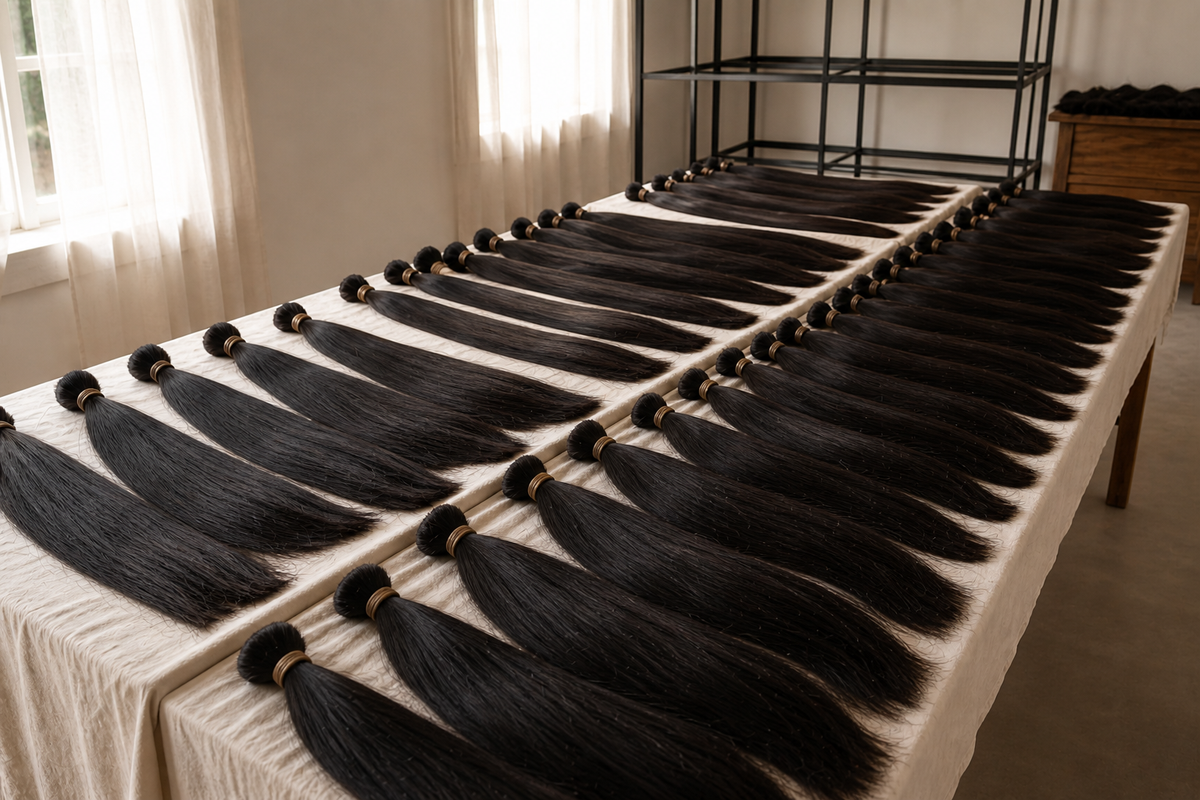
- Direct sourcing (often from original braids)
- Predictable performance
- Built for long-term salon use
I only build my business on the second type.
Because consistency affects everything:
- Install results
- Client retention
- Rebooking rates
What I Look for in Wholesale Hair Extensions (Real Evaluation Criteria)
I don’t trust labels. I trust behavior.
Here’s exactly how I evaluate hair:
1. Cuticle Alignment (Non-Negotiable)
If cuticles don’t align:
- Hair tangles
- Hair mats
- Hair breaks
I don’t try to “manage” it. I reject it.
2. Thickness and Structure (Double Drawn Matters)
I look at:
- Root density
- Mid-length fullness
- Ends
If the ends feel thin, the install will look weak — no matter how I style it.
3. Wash Performance (This Is Where Truth Shows)
I always test:
- Wash
- Air dry
- Brush
Then I check:
- Does it stay smooth?
- Does it dry out?
- Does it tangle?
If the hair fails here, I don’t move forward.
4. Coating vs Real Quality
Some hair feels soft because of coating.
After one wash:
- The coating disappears
- The real texture shows
I only trust hair after that moment.
5. Batch Consistency (Critical for Scaling)
I reorder the same product and compare:
- Color
- Texture
- Density
If anything changes, I stop working with that supplier.
Because inconsistency kills:
- Color matching
- Client trust
- Workflow efficiency
Types of Wholesale Hair Extensions I Actually Use in Salon Work
I don’t choose based on trends. I choose based on efficiency and results.
Tape-In Extensions (Best for Volume Business)
I use tape-ins when I want:
- Fast installs
- Repeat clients
- Scalable services
But I only rely on them if:
- Adhesive holds consistently
- Hair doesn’t slip or shed
Weft Extensions (Best for Premium Services)
These give me:
- More volume
- Better structure
- Higher ticket services
From my experience:
- Hand-tied → more natural finish
- Machine weft → stronger and more durable
- Genius weft → flexible and thin
Pre-Bonded (Keratin Tips)
I use these selectively.
They:
- Take more time
- Deliver long-term results
- Fit higher-end clients
My Wholesale Strategy
If I build a system:
- Tape-ins → volume and turnover
- Wefts → premium positioning
That balance keeps my revenue stable.
How I Choose a Wholesale Hair Extensions Supplier (Step-by-Step System)
I never commit based on a single order.
I follow a process.
Step 1: Multi-Order Testing
I order multiple times and compare:
- Batch consistency
- Color stability
One good sample means nothing.
Step 2: Real Usage Testing
I:
- Install
- Wash
- Reinstall
Then I observe performance over time.
Step 3: Sourcing Evaluation
From what I’ve seen, suppliers who control sourcing directly — especially from original braids — produce far more consistent hair than suppliers using mixed factory hair.
That difference shows up after weeks, not on day one.
Step 4: Restock Reliability
If a supplier can’t:
- Maintain stock
- Keep consistency
I can’t build a system around them.
Step 5: Communication & Understanding
I prefer suppliers who understand:
- Salon workflow
- Color matching needs
- Long-term usage
Not just selling products.
Common Mistakes When Buying Wholesale Hair Extensions
I’ve made these mistakes before. I don’t repeat them now.
Mistake 1: Choosing Based on Price
Cheap hair leads to:
- Redo work
- Client complaints
- Lost time
Mistake 2: Ignoring Batch Differences
Same product name doesn’t guarantee same result.
I only trust repeat consistency.
Mistake 3: Skipping Wash Testing
Hair always looks good fresh.
I judge it after washing.
Mistake 4: Trusting Marketing Terms
“Remy” doesn’t guarantee performance.
I verify everything through testing.
What High-Quality Wholesale Hair Extensions Actually Look Like
I define quality through behavior, not claims.
High-quality hair:
- Stays smooth after multiple washes
- Maintains fullness from root to tip
- Has minimal short hairs
- Moves naturally
- Resists tangling
From my experience, hair sourced from original, intact braids delivers the most stable results over time.
Wholesale Hair Extensions Checklist
If someone asks me how to choose wholesale hair extensions, I give this:
Checklist:
- Cuticles aligned in one direction
- Double drawn thickness
- Minimal coating
- Stable color across batches
- Performs well after washing
- Reliable restock capability
- Supplier understands salon needs
FAQ: Wholesale Hair Extensions
What are wholesale hair extensions?
Wholesale hair extensions refer to bulk-supplied hair products designed for stylists, salons, or resellers, usually with lower per-unit cost and scalable supply.
Are wholesale hair extensions always lower quality?
No. Quality depends on sourcing and processing, not pricing. Some wholesale suppliers deliver premium-grade hair.
How long do wholesale hair extensions last?
High-quality hair typically lasts 6–12 months or longer with proper care and correct installation.
How do I know if a supplier is reliable?
I test across multiple orders, evaluate wash performance, and check consistency over time.
Final Thoughts: I Choose Stability Over Price
Wholesale hair extensions don’t just affect my installs.
They affect:
- My time
- My reputation
- My client retention
When I choose the right supplier, my work becomes predictable.
When I choose wrong, everything becomes harder.
So I stopped chasing deals.
I choose consistency.